Redwood Movements Guide
The Movement Guide: What's Inside Your Redwood Watch, and Why It Matters
If you've been browsing our collection and found yourself wondering what the difference is between a Solar, a Quad-Pulse, a Meca-Quartz, and an Automatic — you're not alone. It's one of the most common questions we get, and it's a good one. The movement is the heart of a watch. It's the engine that keeps time and drives the hands. Everything else — the case, the dial, the strap — is the body around it.
At Redwood, we use four distinct movement types across our lineup, each chosen deliberately for the watch it powers. Understanding them will help you make a smarter choice and appreciate what's on your wrist.
Let's break them down, one by one.
First, the Big Picture: Electronic vs. Mechanical
Before diving into specifics, it helps to understand the fundamental split in the world of watch movements.
Electronic movements (quartz, solar) use a battery or rechargeable cell to send electrical current through a tiny quartz crystal. That crystal vibrates at an extremely precise frequency — 32,768 times per second — and those vibrations regulate the timekeeping. The result is exceptional accuracy, very low maintenance, and high reliability. The seconds hand on a quartz watch typically ticks once per second in a sharp, step-by-step motion.
Mechanical movements (automatics) have no battery. Instead, they are powered by a coiled spring — called a mainspring — that stores energy and releases it gradually through a series of gears and a balance wheel. In an automatic (also called self-winding) movement, the mainspring is wound by a small rotor that spins with the natural motion of your wrist as you go about your day. The seconds hand on a mechanical watch sweeps continuously and smoothly around the dial, a motion many watch enthusiasts find deeply satisfying to watch.
Each approach has its strengths. Neither is universally better. The right choice depends on how you'll use the watch and what matters most to you.
Movement #1: Solar (Epson VS37)
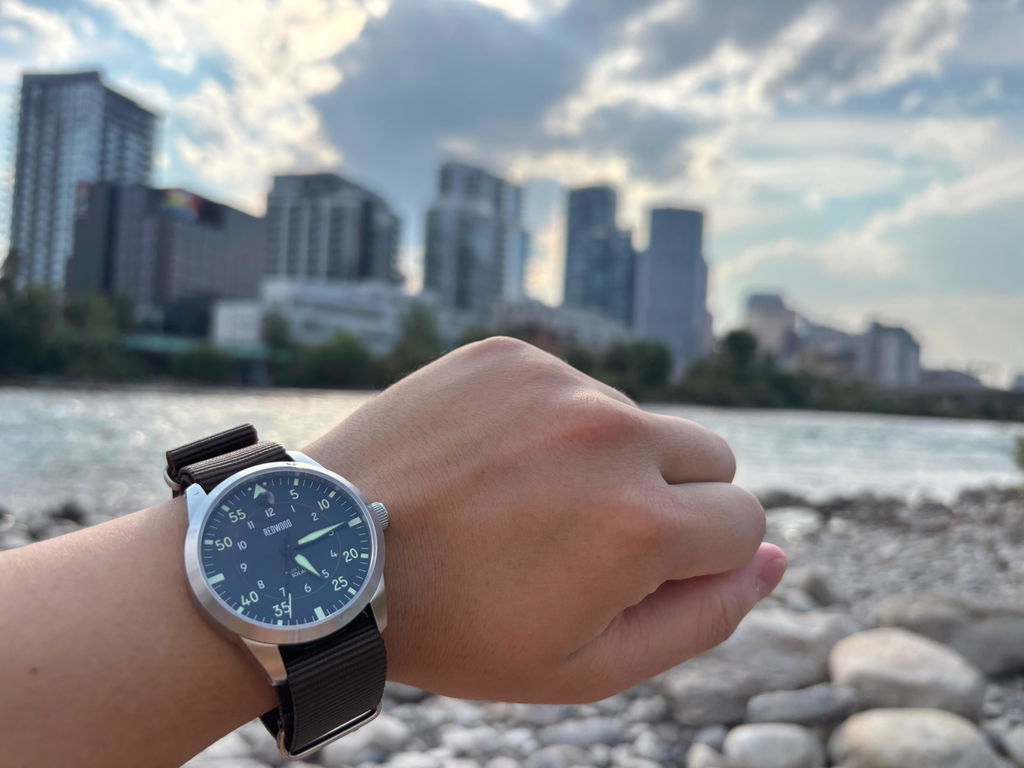
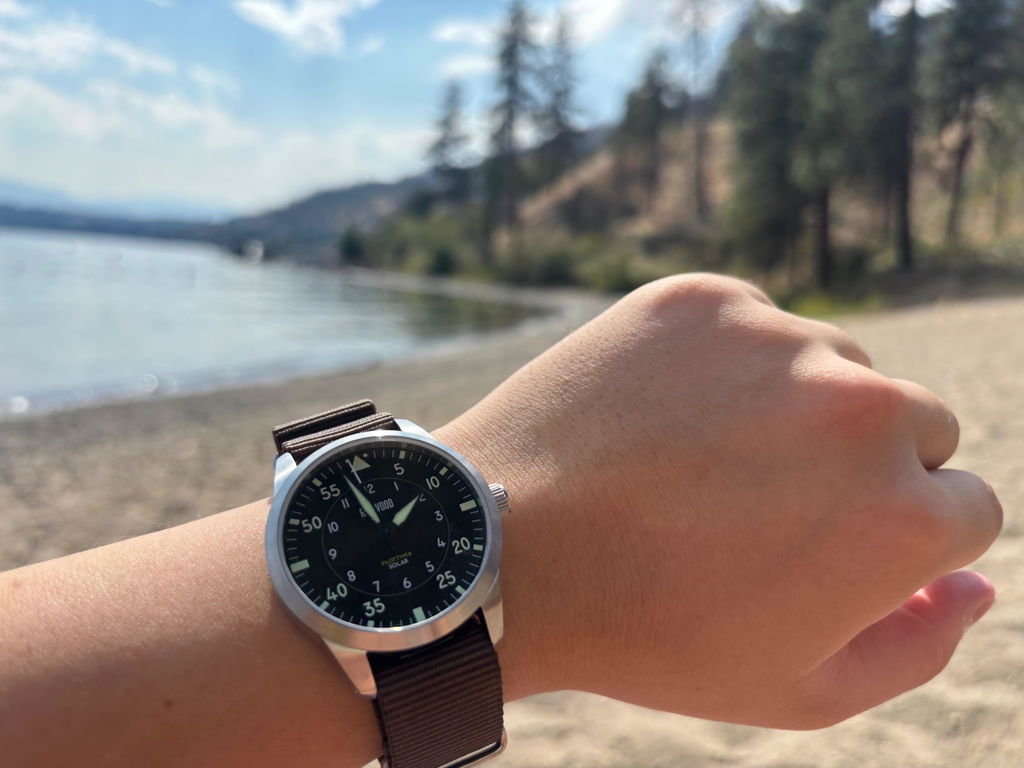
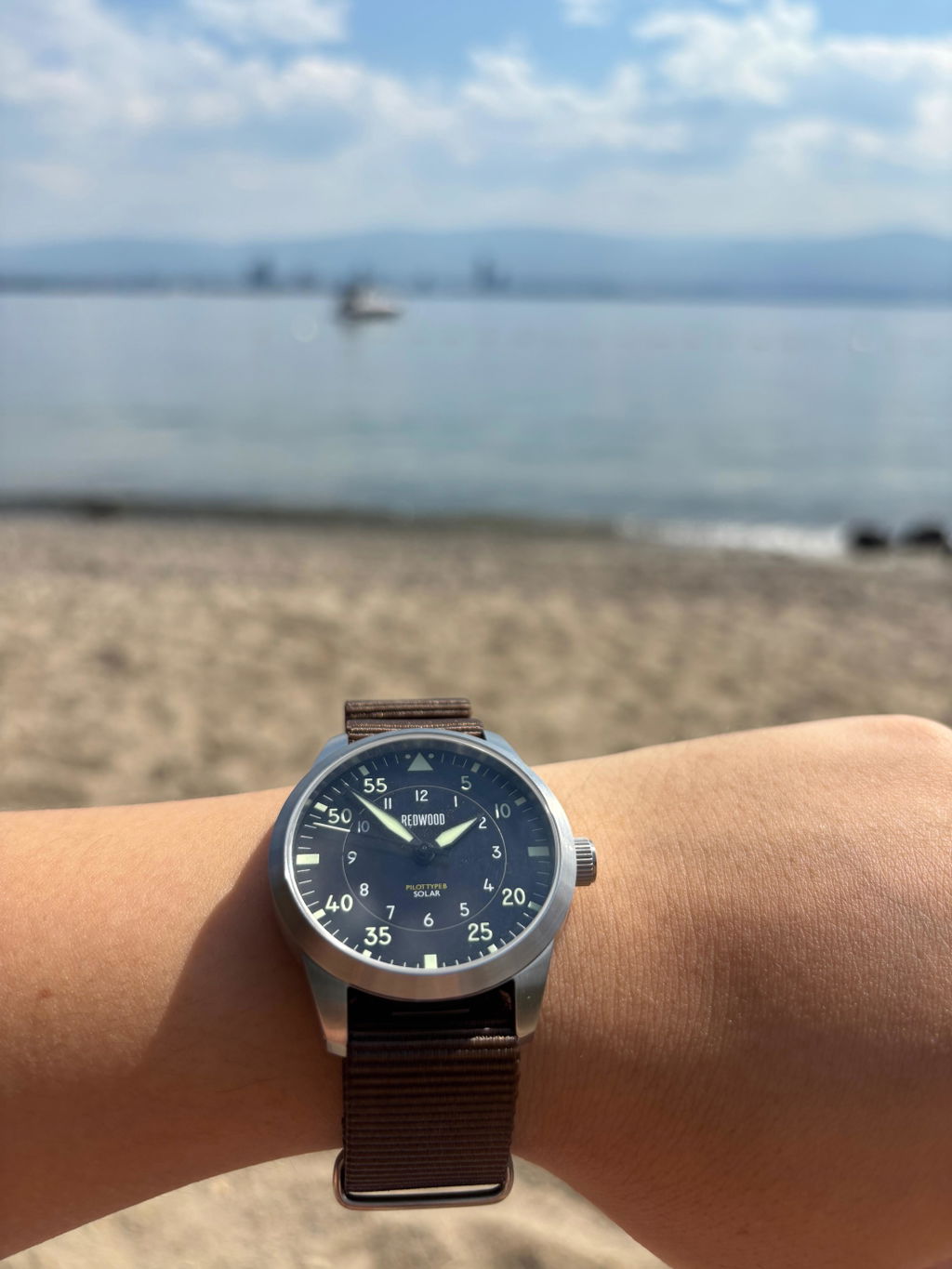
Found in: Kilroy Solar, Monsoon Solar, Field v3 Solar, Tactical v3 Solar, Pilot Type B Solar, Pilot A-13 Solar
How It Works
The Solar movement is a quartz movement with a crucial twist: it doesn't need battery changes. Beneath the translucent dial sits a miniature solar cell — essentially a tiny solar panel — that converts light into electrical energy. That energy is stored in a rechargeable cell inside the watch, creating a power reserve that can keep the watch running for up to 12 months even in complete darkness once fully charged.
Any light source works: sunlight, indoor lighting, even a lamp on your desk. Leave your watch by a window for an afternoon and you've topped it up for months of trouble-free timekeeping.
The specific movement we use is the Epson VS37, a high-grade solar quartz caliber known for its reliability and efficiency. Like all quartz movements, it keeps time to within seconds per month — far more precise than any mechanical watch.
Why We Use It
For most of our field and pilot watches, the Solar is our movement of choice. Here's why: a field watch is supposed to be a tool. It should be there when you need it, without demanding attention. The Solar movement delivers exactly that. No battery changes for years, no winding, no interruption. You strap it on and forget about it — in the best possible way.
It's also the greenest option. Over the life of a watch, a solar movement means dozens of disposable batteries you never have to buy or discard.
Advantages at a Glance
- Zero battery changes for a decade or more
- Up to 12 months power reserve on a full charge
- Quartz accuracy — precise to within seconds per month
- Eco-friendly — rechargeable cell, no battery waste
- Virtually zero maintenance beyond the occasional charge
Best For
The Solar is the ideal everyday companion and adventure watch. It suits the hiker who spends weekends in the backcountry, the traveler who can't be bothered with watch maintenance, the minimalist who wants one watch that just works, and anyone who values sustainability. It's also perfect for someone buying their first serious watch who wants maximum reliability with minimal fuss.
Picture this: you're three days into a week-long trek in the mountains. You haven't thought about your watch once. It's been sitting on your wrist, charging quietly every time you step into a clearing, keeping perfect time through rain, cold, and rough terrain. That's the Solar experience.
SHOP SOLAR WATCHES
Movement #2: Quad-Pulse (Seiko VH31)
Found in: Kilroy Quad-Pulse, Pilot A-13 Quad-Pulse, Pilot Type B Quad-Pulse, Vulcan
How It Works
The Quad-Pulse is also a quartz movement — battery-powered, accurate, low maintenance. What makes it different is the way the seconds hand moves. A standard quartz movement ticks the seconds hand once per second in a sharp, mechanical step. The Seiko VH31 ticks four times per second instead, creating a smooth, flowing sweep that is visually almost identical to the continuous sweep of an automatic movement.
The "Quad" in Quad-Pulse refers to those four pulses per second. The result is a seconds hand that appears to glide around the dial rather than click around it.
Why We Use It
Some watches just look better — feel more alive — with a sweeping seconds hand. Our pilot-inspired designs, in particular, are rooted in an era when cockpit instruments and issued military watches all had mechanical movements with sweeping seconds. The Quad-Pulse lets us honor that visual heritage authentically, without sacrificing the reliability and accuracy of quartz.
It's a battery-powered movement, so it requires a battery change roughly every two years — a simple, inexpensive service. What it gives you in return is the elegance of a mechanical-looking seconds hand with the precision of quartz: accuracy of ±15 seconds per month, which actually outperforms many certified mechanical chronometers that cost many times more.
Advantages at a Glance
- Sweeping seconds hand — the visual character of a mechanical, the precision of quartz
- Quartz accuracy — ±15 seconds per month
- Fewer moving parts than a true automatic — greater field reliability
- No winding required
- Battery life of approximately 2 years
Best For
The Quad-Pulse is for the watch lover who wants the look and feel of a sweeping seconds hand without the maintenance and accuracy trade-offs of a true mechanical movement. It's an excellent choice for a pilot watch, an everyday wear piece, or any situation where you want a watch that looks traditional but performs with modern dependability.
If you're drawn to the aesthetic of vintage aviation watches — the kind worn by fighter pilots and Cold War-era navigators — but you want a watch you can set and forget between battery swaps, the Quad-Pulse is your answer.
SHOP QUAD-PULSE WATCHES
Quick Recap: Solar vs. Quad-Pulse
Both are quartz movements. Both are accurate and low-maintenance. The key differences:
| Solar | Quad-Pulse | |
| Power source | Light (rechargeable) | Battery (replaceable) |
| Battery changes | Rarely, if ever | ~Every 2 years |
| Seconds hand | Single tick per second | Smooth sweep (4 ticks/sec) |
| Best for | Go-anywhere reliability | Classic aesthetic + precision |
If you never want to think about your watch's power source, choose Solar. If the sweep of the seconds hand is important to you, choose Quad-Pulse.
Movement #3: Meca-Quartz (Seiko VK63)
Found in: Recon
How It Works
The Meca-Quartz — short for "mechanical-quartz" — is a hybrid movement, and it's something genuinely special. It combines a standard quartz timekeeping base with a mechanical chronograph module. The result: the watch keeps time with quartz precision, but the chronograph (stopwatch) function operates through real mechanical gears and levers, triggered by the pushers on the side of the case.
The Recon uses the Seiko VK63, a movement in this hybrid family known for a particular feature: a 5 Hz sweeping seconds hand on the chronograph. When you start the stopwatch, the central chronograph seconds hand sweeps at five beats per second — smoother than most quartz chronographs, and more dynamic than a typical ticking hand. It delivers the visual excitement of a mechanical chronograph with the consistency of quartz regulation.
Why We Use It
The Recon is our pilot chronograph. It was inspired by the stopwatch-equipped timepieces issued to military aviators from the Second World War onward — watches that needed to be precise, readable, and mechanically dependable under stress. A mechanical chronograph of similar quality to what the Recon offers would cost several times more to produce and would require more regular servicing.
The Meca-Quartz gives us the best of both: the feel, the action, and the visual character of a mechanical chronograph, with the accuracy and reliability of quartz. When you press the pushers on a Recon, you feel real mechanical resistance and engagement. The reset snaps the hand cleanly back to zero. It's deeply satisfying — and it's accurate.
Advantages at a Glance
- True mechanical chronograph action — real gears, real feel
- 5 Hz sweeping chronograph seconds hand — smooth and precise
- Quartz accuracy for timekeeping
- More affordable and reliable than a comparable full-mechanical chronograph
- Battery-powered, approximately 2-year battery life
Best For
The Meca-Quartz is for the person who wants a chronograph — a watch with a built-in stopwatch function — and wants it to feel authentic. It suits pilots who need to time intervals, racers who want a proper tool watch, and anyone drawn to the heritage of the military pilot chronograph. If you're the kind of person who actually uses the stopwatch function, and you want a satisfying, reliable experience when you press those pushers, the Recon with its Meca-Quartz movement is purpose-built for you.
SHOP MECA-QUARTZ WATCHES
Movement #4: Automatic (Miyota 82S0 and Seiko NH34 / NH36 / NH38)
Found in: Tactical v3 (Miyota 82S0) · Marine Engineer, Jetstream GMT, Standard Issue Officer / Commando GMT / Kilroy GMT / Typhoon (Seiko NH34, NH36, NH38)
How It Works
An automatic movement is a fully mechanical watch. There is no battery, no electronics, no quartz crystal. Inside the case is a precise arrangement of springs, gears, and a weighted rotor called an oscillating weight. As you move your wrist throughout the day, that rotor spins and winds a mainspring, which stores energy and releases it gradually to power the watch.
The result is a seconds hand that sweeps continuously and fluidly — not in steps, not four times a second, but in one unbroken arc. It's the original sweeping seconds hand, and for many people, watching it move is a large part of the pleasure of wearing a mechanical watch.
Our automatic lineup uses movements from two of the most trusted names in the industry. The Miyota 82S0 powers the Tactical v3, offering smooth, reliable performance well suited to a rugged dive watch. The Seiko NH series — specifically the NH34 (GMT), NH36, and NH38 — powers our more complex automatic models. The NH34 is particularly notable: it includes a true, independently adjustable GMT hand, allowing the wearer to track a second time zone by simply setting a fourth hand to point at a 24-hour scale on the bezel or dial. This is what makes the Jetstream GMT, Kilroy GMT, Commando GMT, and Typhoon such powerful travel and pilot tools.
Why We Use It
We offer automatics because some people want — and deserve — a watch that is entirely mechanical. There's a different relationship between wearer and watch when no battery is involved. The watch is kept alive by your movement. Wear it regularly and it never stops. Take it off for a few days and it winds down, requiring you to give it a shake or set it by hand before wearing it again. That engagement is part of the appeal.
Automatic movements also allow for the display of the movement itself. Our automatics with exhibition casebacks let you see the rotor spinning, the gears turning, the escapement ticking — the entire mechanical spectacle laid bare. It's watchmaking made visible.
The trade-off is that automatic movements are less accurate than quartz. Expect around ±10–20 seconds per day for a well-regulated automatic — that's roughly 5 to 10 minutes per month of potential drift, compared to a few seconds per month for quartz. You'll likely need to set your automatic watch more often. For most wearers, that's a minor inconvenience, and part of the ritual.
Advantages at a Glance
- Truly mechanical — no battery, ever
- Self-winding from daily wrist movement
- Genuine continuous sweep seconds hand
- Deep heritage and connection to traditional watchmaking
- GMT variants allow tracking of multiple time zones
- Exhibition casebacks can reveal the movement in action
Best For
The automatic is for the watch enthusiast who wants a deeper relationship with their timepiece. It suits the traveler who needs GMT functionality across time zones (Jetstream GMT, Kilroy GMT, Commando GMT), the diver who wants a robust mechanical movement built to perform under pressure (Marine Engineer), and the collector who appreciates the craft inside the case as much as the design on the outside.
It's also a meaningful choice for someone purchasing a watch as a long-term piece or a gift. An automatic with no battery to replace and no electronic component to fail can outlast its owner — properly cared for, a quality mechanical watch can run for generations.
If you've always been curious about mechanical watchmaking, our automatics are an accessible entry point. They perform beautifully every day while giving you something to admire every time you glance at the dial.
SHOP AUTOMATIC WATCHES
The Full Recap: All Four Movements at a Glance
| Movement | Power Source | Seconds Hand | Accuracy | Best For |
|---|---|---|---|---|
| Solar (Epson VS37) | Light / rechargeable | Single tick per second | ± 20 sec/month | Worry-free everyday & adventure use |
| Quad-Pulse (Seiko VH31) | Battery (~2 yrs) | Smooth sweep (4×/sec) | ±15 sec/month | Classic look, quartz reliability |
| Meca-Quartz (Seiko VK63) | Battery (~2 yrs) | Sweep on chrono (5×/sec) | ±20 sec/month | Pilots, chronograph lovers |
| Automatic (Miyota / Seiko NH) | Your wrist movement | True continuous sweep | -20+40 sec/day | Enthusiasts, travellers, collectors |
So, Which Should You Choose?
Choose Solar if you want a watch that takes care of itself, thrives outdoors, and never needs a battery change. It's the most practical everyday choice in our lineup and the one we reach for when conditions demand maximum reliability with zero maintenance.
Choose Quad-Pulse if the aesthetic of a sweeping seconds hand matters to you and you want the precision of quartz. It's the right balance of old-school character and modern dependability for a pilot or field watch.
Choose Meca-Quartz (the Recon) if you want a chronograph and you want that stopwatch to feel real and mechanical when you use it. It's the only movement in our lineup that gives you a functional, satisfying stopwatch built on genuine mechanical action.
Choose Automatic if you want a fully mechanical watch — one powered by your own movement, with a true sweeping seconds hand and, in our GMT variants, the ability to track multiple time zones. Choose it if you're drawn to traditional watchmaking, or if you're buying a watch you intend to keep and pass on.
If you have any questions about which movement is right for you, don't hesitate to reach out. We're here to help you find the right watch — not just sell you one.